

Beam Me Up, Scotty!
Published on January 22, 2026


So, what do those utterances from Captain James T. Kirk of the Starship Enterprise have to do with marina design? Well, just that Captain Kirk has given us the road map for succeeding in creating a marina that is as well-performing as possible, even if the circumstances might outwardly look like there is little chance of success. The Star Trek story transcends generations, but in each generation’s version, remains the tale of how Captain Kirk, while a cadet at Starfleet Academy, managed to defeat a test intentionally created as a no-win scenario, called the Kobayashi Maru. How did he do it? He managed to change the rules.
Many marina owners are dealing with facilities with 30-year life spans that might be approaching the end of their usable life. Other owners might want to create something new, but the new marina site is less than ideal and difficult to adapt in an affordable way. It’s time to make the move into the 21st century in how to approach creating a state-of-the-art, well protected, marina. So, what to do?
Value Analysis
If we look at the challenge through the same lens of what we did 20 or 30 years ago, we are likely still thinking in terms of what was the state-of-the-art and standard in technology then. What brute force approach can we take to make a marina as calm and protected as possible? Here is where Captain Kirk’s gambit comes into play. Rather than just defaulting to “this is how it is”, can we instead find a way to create a scenario where the rules are suddenly reformulated to our advantage?
Sometimes the answer to that starts with defining exactly what the objective is. We call that value analysis. This does not mean finding the lowest cost option; it is much more than that. It is finding the optimum way of delivering whatever it is you want to deliver by looking at all aspects of the challenge, not just the result, and then finding the best way to address each of those aspects (or functions that must be satisfied). Only then do you constitute a solution using the optimum functional parts. Ironically, value analysis may even reveal a flaw you had not considered, which could lead to a higher cost, but in doing so, protecting you from that unrecognized risk.
As an example, imagine you need to cross a river. Our mind immediately jumps to needing to build a bridge, and that certainly could work. But what about digging a tunnel, or giving helicopter lifts over the water, or even a nice sturdy rope swinging from a tree limb, or even just swimming? See, we didn’t say anything about how fast you needed to cross the river, or if it had to be by car, or even how much traffic is involved. We just imposed constraints on ourselves that may or may not be necessary. Those artificial constraints then force decisions that may not be ideal.
As we plan a marina, one of our first concerns is providing adequate protection from Mother Nature, whether it be winds, waves, currents, or even sediment ingestion. The typical brute force approach is to just build a breakwater or wall to block whatever is expected to be the problem. Ironically, that may not be the best solution and certainly may not be the cheapest.
Tackling a Challenge
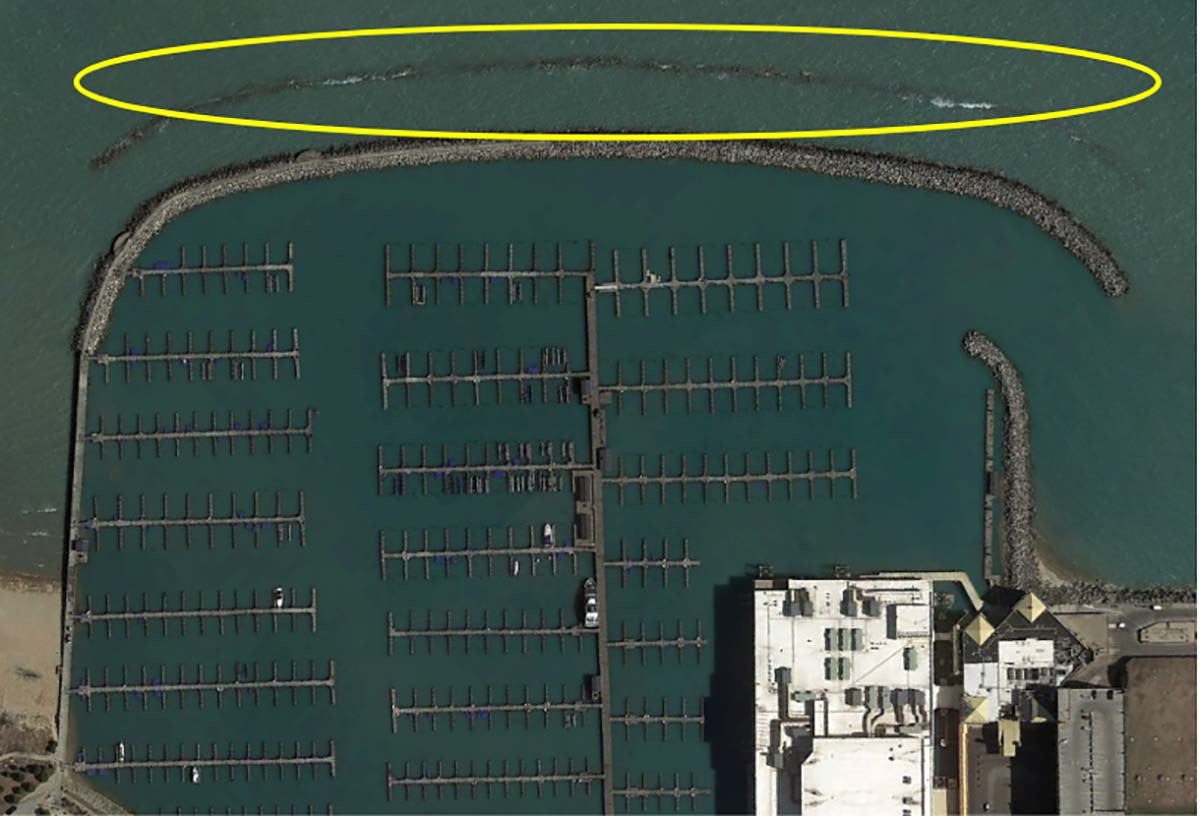
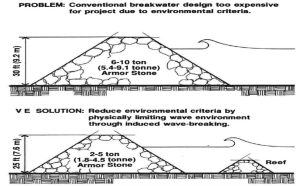
To build the new marina at Hammond, Indiana, located at the southern end of Lake Michigan, the initial scoping of a breakwater revealed that the size of the armor and the mass of the breakwater required to resist the gale-forced storm waves was so great that the structure could not be affordably built. Let’s take a look at how a Captain Kirk approach might make this solvable. Drilling into the problem, we discover that the underlying issue is that the waves are too big to be affordably addressed.
What if something is put out in front of the breakwater that trips the biggest waves, causing them to break before impacting the breakwater? Through a little analysis of wave behavior and some laboratory testing, we can figure out the physics of what is going on. In this case we discover that if we construct two structures, a submerged reef and a less massive main breakwater, the combination of which is equally effective, but costs less in total than one massive breakwater, we have a viable, now affordable alternative.
This was the solution for the Hammond, Indiana, marina breakwater. This not only made the project feasible, but it has now performed for more than 30 years without need for repair, proving that this approach was not only a more economical alternative, but also more resilient to climate change, as the bigger the waves are, the more they can be induced to break before hitting the structure.
Creating a Strategy
The strategy for wave protection may not even need to be a structural change at all but could still involve changing the incident climate so that conditions will be more tolerable. For Marina Papagayo in Costa Rica, the problem was a serious issue: long waves arriving from the South Pacific were penetrating through to the marina location and, because of a hard shoreline, were reflecting back into the marina basin, making the berthing agitation too great.
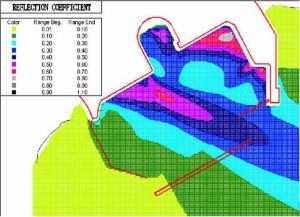
Figure 1 shows the predicted agitation level based on an initial shoreline alignment that roughly paralleled the existing natural shoreline. The dark blue and purple shades show that there is significant agitation due to the reflections from the shoreline, occurring in the middle of where all the berthing is planned.
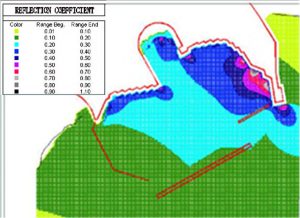
Figure 2 shows that by adjusting the apparent shoreline alignment, giving it a virtual reorientation relative to the approaching waves, while not really altering the utility of the waterfront, the entire harbor agitation issue was made to disappear.
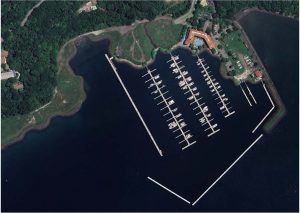
Figure 3 shows the marina, half completed as Phase 1, where the shoreline has intentionally been realigned, and undulations added to further defeat reflected wave action. In this case, the need for the outer breakwater was eliminated using, instead, only a less robust floating wave attenuator to address locally generated wind waves in the bay.
Once again, the strategy for harbor protection did not require the construction of a massive barrier to prevent the waves from arriving but rather a design to manage which way the waves are reflected.
Wave attenuation strategies still fundamentally rely on the ability to damp, block, or redirect wave action. This can occur both on a more micro scale, relying on the device to locally do its work, but also on the macro scale, not necessarily requiring the introduction or addition of supplemental protection devices. In the ideal situation, by fully understanding and then leveraging the wave and current behavior to work for you instead of against you, it is possible to transform untenable options into viable ones.
So, “Beam me up, Scotty!”, we’re now ready to boldly go where no one has gone before.
Jack C. Cox, P.E.; BC.CE, BC.PE, BC.NE is the director of engineering at Edgewater Resources. He can be reached at jcox@edgewaterresources.com.

| Categories | |
| Tags |