

Dockside Fuel Delivery Expands Marina Revenue Streams
Published on April 28, 2026


For marina operators, fuel sales are often a key driver of overall revenue. Demand typically remains consistent throughout the season, and margins can be attractive. However, it also requires ongoing investment, trained staff and close attention to safety and regulatory compliance.
Now, a new approach makes it possible for marinas to provide fueling services without the cost and operational burden. Instead of managing the entire fueling system and its associated legal and compliance obligations on the dock, the operation is handled by a purpose-built vessel.
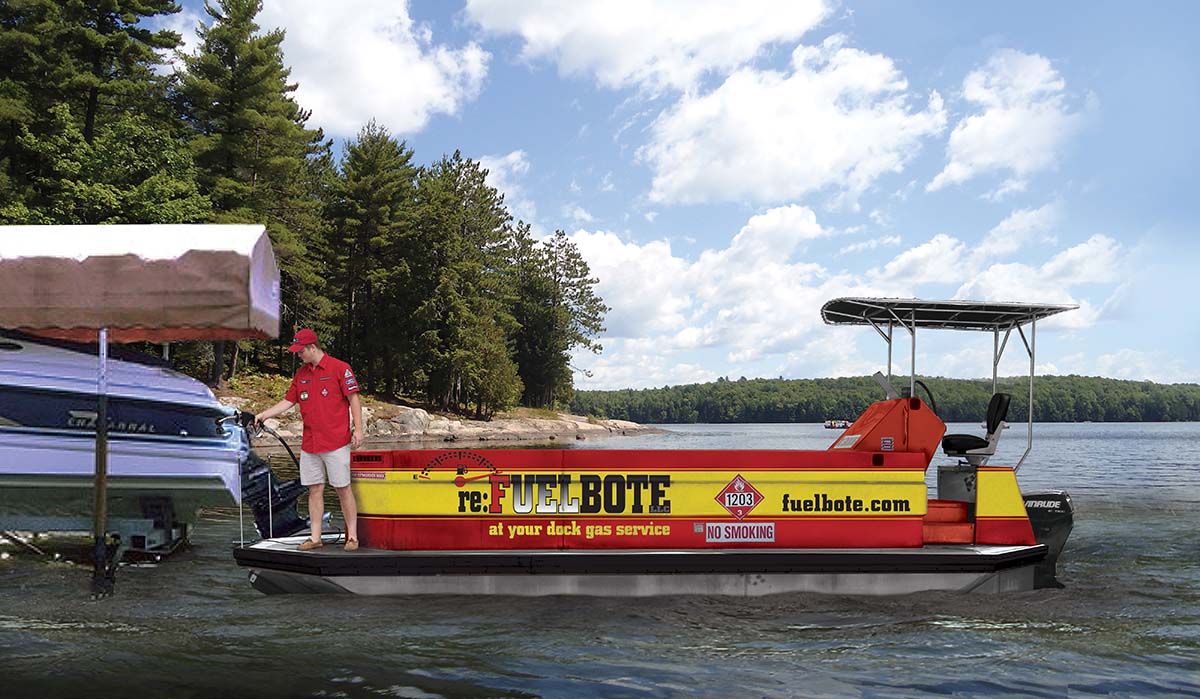
Operated by a single licensed captain, this specially designed boat delivers fuel directly to customers while their vessels are moored or on a lift.
Scheduling and billing are handled through a mobile platform that links boaters with the fuel vessel. The barge refuels boats on a defined shoreline route, and payment is completed through an app, as with other marina services.
For marinas, dockside delivery represents a shift in how fueling services are provided and may be the next stage in the evolution of marine refueling, one that brings fuel directly to vessels in a more efficient and convenient way. The business model is also an excellent fit for pier and lift installers that already work on the water.
“This approach enables marinas that lack on-site fueling infrastructure to provide the service without taking on the cost and operational complexity of building and managing a conventional fuel dock. For marinas that already sell fuel, they can expand their operations and capture more business without expanding their physical footprint,” said John Neuens, president of Fuelbote.
Marinas Without Fuel
Fueling is often one of the largest financial hurdles a marina faces. A traditional fuel dock alone can cost $400,000 to $700,000, with shoreline space, permitting and physical site limits pushing the price tag higher. Marinas also take on continuing maintenance, inspection, staffing and insurance obligations tied specifically to fueling operations.
Space constraints further discourage installation. Fueling zones must be separated from other marina activities and designed to allow safe vessel movement and emergency access, which can displace rentable slips and revenue-generating waterfront space.
For smaller marinas, the investment can be difficult to justify. Instead, they direct customers to nearby marinas or municipal docks for gasoline, effectively sending their customers and the associated revenue elsewhere. In some regions, operators may turn to truck-based fueling, which requires extended hose runs across docks, piers, walkways or yards to reach the vessels needing fuel.
“Marinas that do not provide fuel miss out on a meaningful source of revenue, but the financial impact does not stop there,” Neuens said. “Fuel is a basic convenience for most boaters. When they must leave the property to refuel, the marina becomes less central to their routine. Over time, that shift can influence where they dock, store their boats or renew their slips.”
There is also a competitive dimension. In many markets, full-service operations still set the standard. Marinas that cannot provide fuel are often passed over by traveling boaters mapping out their routes, which reduces visibility and limits the chance to build repeat traffic over time.
For marinas that already operate a fuel dock, expanding into dockside delivery can broaden their reach.
“The added flexibility can draw business away from neighboring marinas, municipal docks or other fueling providers by reducing wait times and simplifying the refueling process,” Neuens said. “In doing so, the marina can capture a greater share of fueling demand within the property, without adding fixed infrastructure.”
The Fueling Vessel
According to Neuens, the foundation of the service is the Fuelbote vessel, which is purpose-built for marine fuel transfer and configured around the safety rules that apply to fuel storage and dispensing on the water. Dockside fueling is subject to established fire codes, including National Fire Protection Association (NFPA) standards 30 and 30A, which outline how flammable and combustible liquids are handled in marine settings.
Fuelbote vessels are built on a stabilized barge platform powered by an outboard motor, with thrusters used for positioning. The standard model is 25 feet in length with an 8½-foot beam and can carry approximately 600 gallons of fuel. The barge is built of 303 stainless steel, has a 75-foot, powered auto-retract hose reel and is equipped with unique 13-foot or longer retractable stabilizers to hold the vessel in position during service. All components in the fuel containment area are either rated as explosion-proof or are intrinsically safe solid-state devices.
Like traditional marina fuel facilities, Fuelbote must incorporate spill-prevention safeguards, secondary containment systems and clearly defined operating procedures to prevent fuel from entering the water.
The vessel is designed with a triple-layer fuel barrier that surpasses the federally mandated minimum of two containment layers outlined in the U.S. Code of Federal Regulations (CFR). As an added safety margin, it includes a containment reservoir required to capture fuel if the primary tank leaks or ruptures or if overflow exceeds tank volume by more than 50%.
The vessel is also equipped with onboard environmental response equipment, including skimmers and containment booms. If necessary, it can serve as a support asset for waterway cleanup efforts.
The Fuelbote is equipped with a custom-engineered, proprietary DOT 406 stainless steel onboard tank designed specifically for marine applications. This tank configuration supports full compliance with U.S. Coast Guard (USCG) stability requirements and structural scantling standards.
A standard one-ton heavy-duty pickup truck is sufficient to tow the vessel by trailer under normal operating conditions. The onboard tank is designed to meet transportation standards, enabling a fully loaded vessel to be hauled on United States highways and roads by an operator with a commercial driver’s license with a hazardous materials classification. The testing and licensing for this classification is conducted by each state, but the resulting certification is recognized across all states.
The Fuelbote is typically refueled on land at a wholesale fuel rack, the same type of terminal facility used to fill DOT-approved tanker trucks. If permitted by state regulations, the vessel can be resupplied on the water by a tanker truck service.
The App
A central component of the service is the proprietary, copyrighted software application provided with the vessel and licensed for use, which supports and manages the entire operation.
Scheduling, routing and customer requests are coordinated through the platform that integrates registration, dispatch and billing within a single system. Transactions are processed electronically, while operators monitor fueling activity and service requirements through a centralized dashboard.
Fuelbote is updating the software using artificial intelligence and a helpful avatar to assist boat owners through sign up and to help captains develop an efficient operation of the route based on geolocation of each boat. No addresses or other descriptions are needed for the captain to locate and fill each boat.
Once the route has been established, the Fuelbote travels close to shore at speeds of up to 15 knots. Upon arrival, the vessel secures its position by deploying spud anchors or mooring lines before beginning any refueling operations. Fuel is delivered only to boats that are properly moored or positioned on a lift only. This method conforms to accepted marine fueling practice as described by the USCG Code of Federal Regulations and the NFPA and IFPA fire code, as stated in NFPA 30 and 30A sections on marine refueling.
The vessel is insured according to state and municipal requirements. Operators are trained in fueling procedures and tankerman safety practices.
The Evolution of Marina Fueling
According to Neuens, Fuelbote has already been in productive and safe use for 11 years without complaint or safety incident. During that time, the response from boat owners has been positive.
“Boaters appreciate avoiding the inconvenience that typically comes with refueling,”Neuens said. “In many cases, topping off the tank means leaving their slip and traveling a significant distance to reach a fuel dock, often burning additional fuel to do so.”
On busy summer weekends, lines can form quickly, turning what might be a brief stop into an extended wait along the pier for an open position. Maneuvering at fixed fuel docks can also bring its own challenges. Larger vessels often must ease into tight spaces while working against wind, current and nearby traffic, sometimes with very little room to adjust. Even experienced operators end up edging close to pilings or neighboring boats, and light contact in crowded layouts is part of the reality at busy marinas.
For marinas that do not currently provide fuel, or for those seeking to extend coverage across a larger portion of the lake, dockside delivery service is a practical way to increase revenue without assuming the capital expense or regulatory burden associated with building and operating a traditional fuel dock. Staff hours can be directed toward more productive activities, and fuel is not consumed simply to access fuel.
By adopting this approach, marina operators have a practical means of establishing a more streamlined fueling operation that increases revenue while providing greater convenience and faster service for boat owners.
For more information contact John Neuens at 414-630-7223; email
john@fuelbote.com; or visit fuelbote.com/.

| Categories | |
| Tags |