

Liability Risks Are Hiding in Plain Sight at Marinas, And Operators Can Close the Gaps
Published on October 29, 2026


For marina operators, some of the greatest liability risks don’t always come from dramatic events like hurricanes. It’s the everyday tasks such as moving, storing, fueling and repairing boats that can create a slew of unseen dangers.
These risks are becoming more apparent as boating activity increases and vessel values rise.
“The exposure map is changing,” said John Logothetis, president of Clear Marine Risk Solutions, an insurance provider specializing in coverage for marinas, boat dealers, shipyards and marine contractors.
Severe weather is producing significant losses beyond traditional coastal areas, while social inflation is increasing the potential severity of liability claims.
One of the most overlooked issues, however, may be outdated valuations.
“When a claim comes in, and the numbers on the policy don’t match reality, that gap can become a serious problem,” Logothetis said.
More Boats, More Exposure
Greater boating activity means more customers, vessels and movement throughout a marina, magnifying everyday risks.
Maurice Lee, who manages marine insurance programs as a senior underwriting consultant for Nationwide’s Excess & Surplus/Specialty Division, points to increased foot traffic. “More foot traffic on docks, ramps, service yards and showrooms increases slip and fall exposure for customers,” Lee said.
Moving vessels between slips, conducting sea trials and operating travel lifts and forklifts also involve employees handling other people’s property.
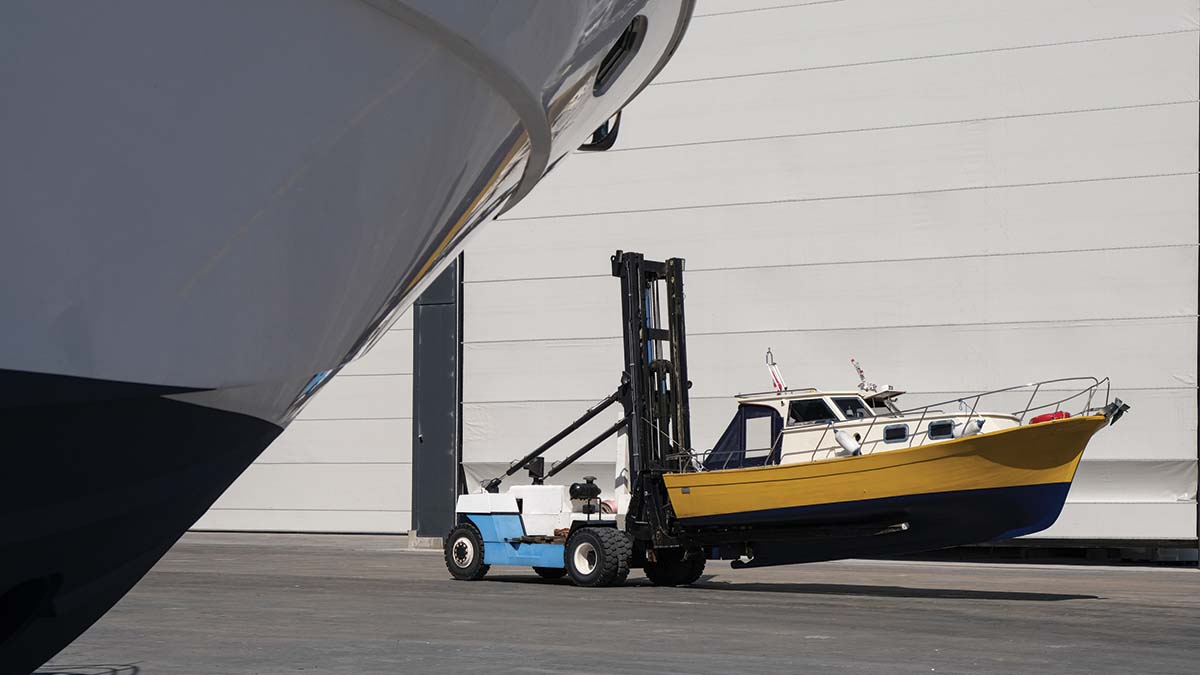
Travel lifts and forklifts represent an “underappreciated double exposure,” Lee said, because moving a customer’s vessel can involve both equipment liability and care, custody and control (CCC) exposure.
Fueling and maintenance add pollution and environmental risks, with more activity creating more opportunities for spills or discharges.
Liability can also continue after a boat leaves the facility. “If repair or haul-out was done improperly, and something fails after the release, that’s a completed operations claim that can surface weeks or months later,” Lee said.
Subcontracted work during busy periods can create additional exposure if the subcontractor’s work and insurance have not been properly addressed.
When a Boat Doesn’t Leave
Supply chain disruptions have created another challenge: customer boats may remain at a marina or service yard far longer than anticipated. A vessel waiting for a backordered part can spend weeks or months in an operator’s CCC, extending the period during which the operator could be responsible if something happens to it.
“The duration of the exposure is one of the primary concerns,” Lee said.
An extended repair cycle increases the possibility of another weather event, theft, a yard accident or damage from another vessel. Meanwhile, CCC limits may no longer reflect the value of boats actually on the premises.
Lee recommends adding up the current retail value of customer vessels an operation might realistically have in its care on a busy day and comparing that figure with the policy’s CCC limit.
“CCC isn’t a set-it-and-forget-it coverage limit,” he said.
As vessel values and repair costs rise, Lee recommends reviewing those limits regularly and considering third-party licensed valuations for higher-value accounts rather than relying on outdated owner estimates.
Routine Operations Need Structure
Sea trials are another everyday activity that can create significant exposure.
“One of the mistakes we always see when it comes to these types of exposures is just a lack of structure,” Logothetis said.
He recommends three basic safeguards: a written pre-departure checklist, a designated and qualified operator and a signed acknowledgment from customers or other third parties participating in the trial. Without those procedures, a routine sea trial can become difficult to defend if an accident occurs.
“Coverage may be available, but without documented procedures and records, there is little evidence to support the argument that the business exercised proper care,” Logothetis said. “In the event of a claim, that lack of documentation can make it difficult to defend against allegations that the accident could have been anticipated or prevented.”
Fueling requires similar consistency. Logothetis recommends written procedures, fueling logs, no-smoking signs and readily accessible spill kits. These measures cost little but can provide valuable documentation if a claim reaches litigation.
Contracts Aren’t the Whole Answer
Marina operators may also assume customer agreements provide more protection than they do.
Slip and storage agreements commonly include indemnification or hold-harmless provisions and require customers to carry insurance, but those provisions do not necessarily eliminate the marina’s own liability.
“If the marina or storage operation itself was negligent — a dock was maintained improperly, a haul-out was mishandled, or there was a fueling error — that indemnification language typically doesn’t hold up,” Logothetis said.
He also identified a common blind spot: failing to consistently track customers’ certificates of insurance and additional-insured status. His recommendation is to review contracts and insurance together with a marine-experienced broker annually.
“Both sides change over time, and they drift apart if no one’s checking naturally,” he said.
Documentation Matters
Strengthening a marina’s risk-management program does not necessarily begin with buying more insurance.
Lee recommends reassessing insured values and limits; tightening procedures around fueling, haul-outs, launches, sea trials and storage; and identifying gaps involving CCC, flood, pollution, cyber, business income and excess liability.
Documentation may be the least expensive measure to implement. “Training records and written procedures are often the very first things a defense counsel asks for,” Logothetis said.
A dated procedure, signed training log or completed fueling checklist can demonstrate that an operation had a defined process rather than relying on informal habits. Documentation can also affect how an account is viewed during underwriting.
Ultimately, operators should evaluate their insurance program against the marina they operate today, not the business they insured several years ago.
“The key is to evaluate coverage before a claim occurs, not after loss when you find that certain risks were uninsured, underinsured or excluded altogether,” Lee said.
In an increasingly complex marine environment, preparation may be one of a marina’s most valuable assets.

| Categories | |
| Tags |