

A Dock That Delivers
Published on March 2, 2026


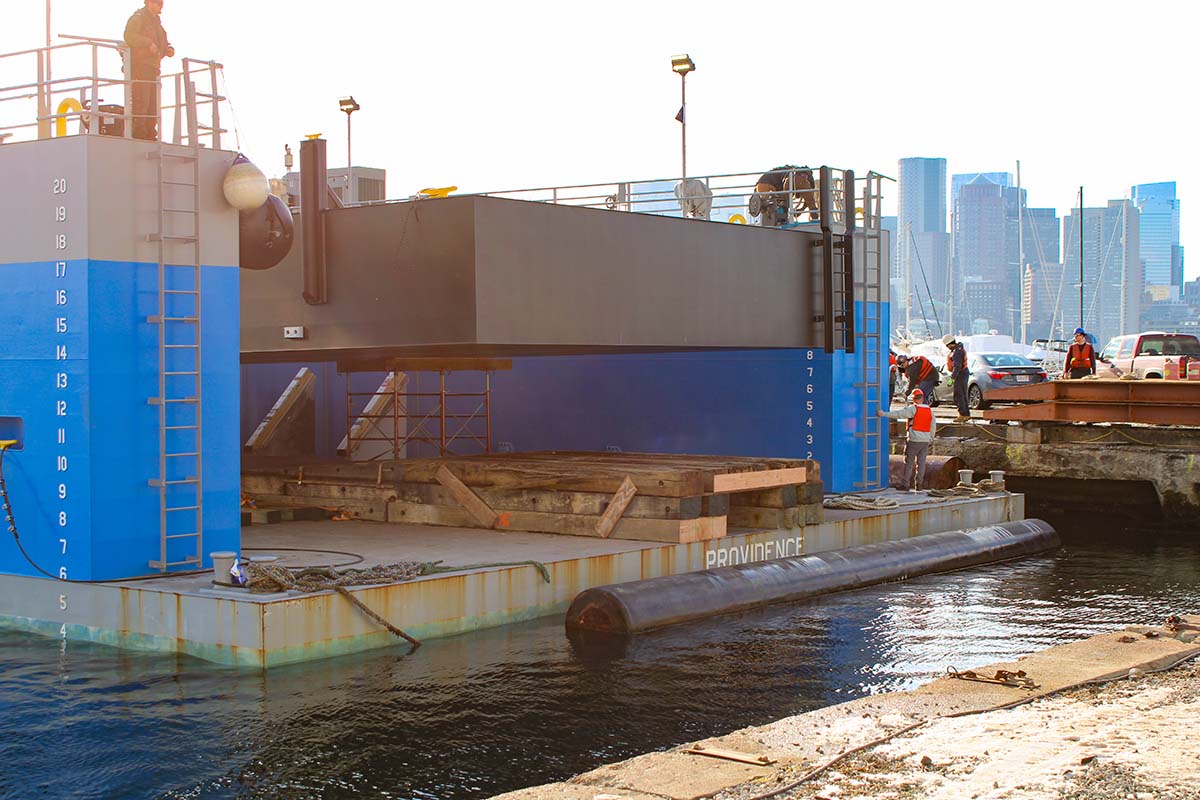
Boston Harbor Shipyard and Marina (BHSM), operated by Ocean Havens, recently completed a significant maritime operation that highlights both the versatility of its facilities and the growing importance of innovative waterfront infrastructure in Massachusetts. Using its 500-ton floating dry dock, Providence, BHSM successfully executed a multi-barge roll-on operation for the Massachusetts Bay Transportation Authority (MBTA), launching ferry terminal barges that will soon serve commuters traveling through Hingham Harbor.
Giant Barges, Big Purpose
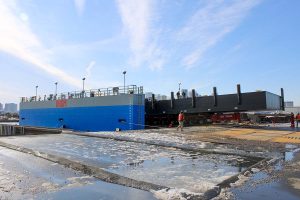
The barges were fabricated by Blue Atlantic Fabricators, a tenant of BHSM, and the only AISC-certified fabrication facility on the East Coast with direct headwall access for water transportation. Designed to function as docks at the MBTA’s Hingham ferry terminal, each barge measures 115 feet by 30 feet and weighs approximately 120 tons. Coastal Marine Construction hired Blue Atlantic Fabricators to build the barges, and they completed the first two of three in November 2025.
Michael Julian, the general manager of Blue Atlantic Fabricators, said that the docks are going to “improve rider experience and bring them into compliance with updated accessibility standards.” Blue Atlantic Fabricators brings a long history of collaboration with the MBTA, spanning “ferry facilities, station structures, bridges, safety railings and a wide range of other infrastructure needs.” For the MBTA, the project represents another step toward modernizing ferry infrastructure while ensuring safe, accessible service for thousands of daily riders.
Rolling Out Success: Tackling Launch Challenges
Once fabrication was complete, the challenge became launching the massive structures efficiently and safely, without disrupting surrounding harbor operations. The solution lay within the shipyard itself. Using self-propelled modular transporters (SPMTs) supplied and operated by Bay Crane Northeast, the completed barges were rolled directly from Blue Atlantic’s fabrication shop onto Providence. A matted runway system that was installed and secured into place thanks to ACK Marine, another BHSM tenant, made the seamless transition possible.
The launch was carefully timed around Boston Harbor’s tidal schedule, which posed a unique challenge. “The operation was completely dependent on tides and required a predicted tide of 9 feet mean low water,” Julian said. “In Boston Harbor, this occurs only 30 to 40% of the time per month, and because the launch had to take place during daylight hours, that window dropped to 15 to 20%.” A late January snowstorm also delayed mobilization, but the team adjusted the schedule to ensure the safest and most effective launch possible.
After transporters cleared the dock, Providence was submerged in a carefully controlled operation, allowing each barge to float free into the harbor.
According to Myles Murphy, dry dock manager at BHSM, the dry dock’s unique capabilities were critical to the success of the launch. “The fact that the dry dock can sink to over 12 feet allows us to block the barge high enough for the self-propelled modular transporter to safely egress from the pontoon deck with room to spare,” Murphy said.
Providence: The Harbor’s Heavy-Lifting Hero
Installed at BHSM in May 2025, Providence is the only floating dry dock currently operating in Boston Harbor. Built in 2021 by Conrad Shipyards and engineered by JMS Naval Architects, the 500-ton dry dock represents a major investment in the region’s maritime infrastructure. Its arrival filled a gap in local vessel-servicing capabilities, allowing commercial operators to conduct maintenance and repairs without leaving the harbor.
“The dry dock is a valuable asset to not only Boston Harbor Shipyard and Marina, but the entire harbor,” Murphy said, “allowing vessel owners and operators to keep their fleets running smoothly without the need for long-distance travel to other shipyards.”
In addition to the dry dock itself, BHSM provides a range of supporting resources, including forklifts, shore power and push boat assistance. As a year-round marina with 180 slips and a 50-ton travel lift, the facility serves a mix of recreational and commercial users throughout the Northeast.
Teamwork on the Waterfront
Murphy emphasized the collaborative nature of the project, which contributed to the success and impact on thousands of daily commuters. Boston Harbor Shipyard and Marina, Blue Atlantic Fabricators, Bay Crane, ACK Marine, A. Waller Associates and JMS Naval Architects worked in close coordination, with engineering efforts ensuring that all plans were safely and efficiently executed in a flawless collaboration that will benefit the community.
“This is a great example of what can be achieved when shipbuilders, heavy-lift specialists, naval architects and shipyard operators work as one team,” Murphy said. “I am proud of the group effort.”
Ferrying Forward: Impact on Riders and the Region
Macy Jones, marketing manager at Ocean Havens, highlighted the broader significance of the project for both riders and the region’s water transportation network. “The new docks in Hingham will greatly improve the rider experience for users of the ferry route,” Jones said. “It’s an overall improvement to the water transportation network, which is a win for the entire harbor. We are proud of all the members of the working waterfront who came together to make this possible and to showcase how important it is to have designated port areas for jobs like these.”
The teamwork reflected a broader, longstanding relationship between Ocean Havens and the MBTA. Over the years, Ocean Havens’ affiliated companies have supported the agency’s marine operations in multiple capacities, including providing fuel to the MBTA fleet through Harbor Energy, offering dockage at several Ocean Havens-operated marinas and delivering vessel maintenance services through Boston Marine Services.
The collaboration carried implications beyond the shipyard gates. Massachusetts continues to invest heavily in water transportation infrastructure, and the success of projects like this demonstrates how strategic waterfront assets can support public transit goals. BHSM’s central location in East Boston proved to be a key factor in the project’s viability.
“When we first commissioned the dry dock, we never imagined it would be used in such a unique way that would impact thousands of commuters daily,” Murphy said. “Our engineering collaboration and teamwork with our tenants proved that this is not only a safe and effective launching method, but it is also repeatable.”
What’s Ahead for Providence
As ferry service continues to play an important role in the region’s transportation network, the ability to fabricate, launch and maintain infrastructure locally becomes increasingly valuable. The MBTA barge launch serves as a clear demonstration of how specialized facilities like Providence can support large-scale, complex maritime projects while strengthening the broader harbor economy.
Looking ahead, the Providence dry dock is expected to support similar projects in the future, “There is still one more barge in this project that needs to be finished and launched, which we will repeat the process once it is complete,” Jones said.
Blue Atlantic fabricates two to three commercial docks of this size and scope per year. “Having a reliable launch facility that is safe and repeatable is very important to our business and clients,” Julian added, underscoring how Providence will continue to play a key role in supporting the region’s maritime operations and economic vitality.
| Categories | |
| Tags |