

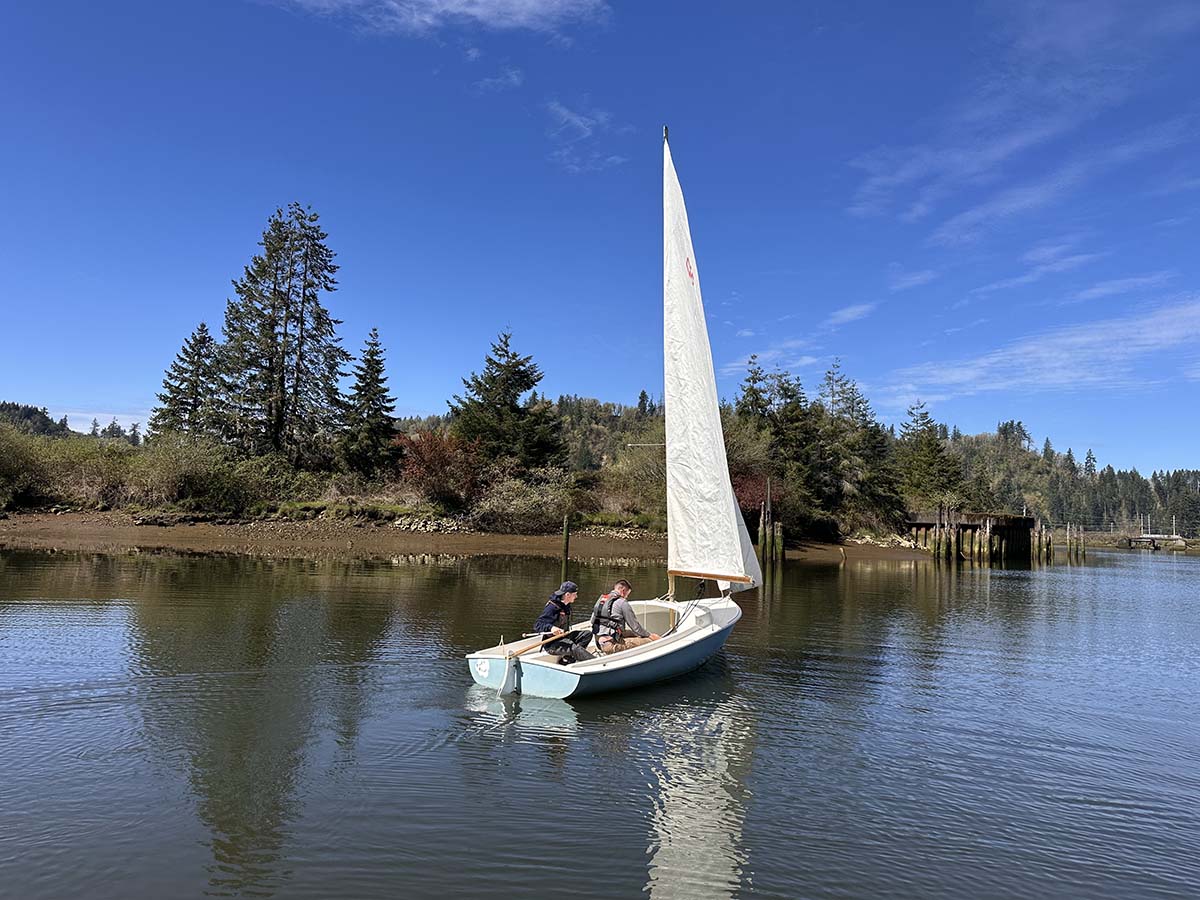
Build Boats and They Will Come
Published on July 1, 2026


The Port of Toledo in Oregon was established in 1910 to support the movement of wood products from the state’s booming lumber industry.
Through the years, the port transitioned from lumber but retained its economic importance with tenants that manufacture products for sale nationally and internationally, a large seafood processing operation and various marine services. Spanning the cities of Toledo and Siletz, the port now encompasses 443 square miles.
Beyond its industrial role, the port has become a recreational hub offering docks, a boat ramp, a paddle park for kayakers and canoers and a waterfront park with a pavilion for events. The port has become a community centerpiece and a second home to a large group of volunteers.
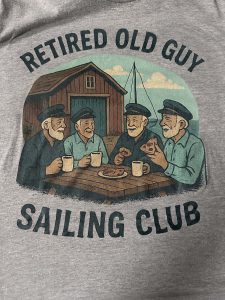
Two boathouses built in the early 2000s have become the heart of not just the port but of the surrounding towns. One houses a workshop and classroom where the Retired Old Guys Sailing Club volunteers gather to work on boats and share their skills with local students and curious observers. The founding principles for the group are “No officers, no dues and no rules.”
The other boathouse stores a collection of more than 30 boats used for Free Family Boating events. The two spaces work hand in hand and together have helped put thousands of new boaters on the water.
The relationship between the port and the Retired Old Guys Sailing Club is reciprocal. The port staff built the first boathouse and the Retired Old Guys built the second. The port provides space, electricity, some funding and helps write grants. In return, the Retired Old Guys helps with maintenance around the port.
“The guys work on the boats that we own that need care, and they do community projects like building a bookshelf for the library. They have such a wide range of technical skills: mechanic, engineer, steamboat captain and all these different experiences, so they parse out the work that needs to be done,” said Debbie Scacco, port manager.
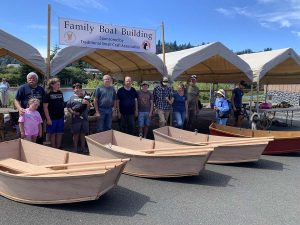
Woodshop
The original boathouse coordinated with the Oregon Coots, a nonprofit association under the national Traditional Small Craft Association that supports people who use and build traditional small craft. “They’d just build boats, and the community started using the boats. Volunteers showed up when they had time,” said Joe Novello, volunteer coordinator for the Free Family Boating program. “I was the coach of the Newport High sailing club, and the Port of Newport donated a boathouse for us to use. I noticed people visited all the time, so I started a free boating program there.” The Port of Newport was a challenging location with all the fishing activity, and participation was low, so Novello jumped when the port manager at Toledo asked if he wanted to relocate the program.
“Toledo’s heritage is boating, and there are lots of boatbuilding talents still around. We wanted to tap into that and push those skills. We just needed the volunteers to buy in and do it,” Scacco said. While Scacco wasn’t the manager at the time, she appreciates the foresight of her predecessor. “Our previous port manager just wanted this here. It’s grown and continued giving hands-on experience with boatbuilding, maintenance, sailing and seamanship,” she said.
Volunteers have built more than 100 wooden boats, some of which are used for the free boating program and others which were sold to provide funds for more boat building projects. The group builds kits for the construction of 8-foot skiffs that they sell during the port’s annual Wooden Boat Festival. They also construct more than 300 model wooden boats with kids who attend the show. Materials come from sponsorship from the Traditional Small Craft Association.
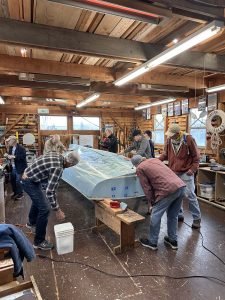
The Retired Old Guys aren’t the only ones who show up at the workshop. Several kids between the ages of 10 and 18 show up each week to learn about boatbuilding, maintenance and repair. Novello said they are mostly homeschooled kids, but sometimes students from the high school come down as well. “I retained my teaching credentials so kids can get high school credit for the work they do at the boathouse,” Novello said.
Free Family Boating
The other boathouse hosts Free Family Boating Days every Thursday throughout the summer and sometimes a bit longer. The activity is run by volunteers who mostly come from boating backgrounds. There are several certified instructors through the American Canoe Association and US Sailing, and other volunteers are certified Water Safety Instructors. Families simply show up, sign a waiver, get a life jacket and choose among 37 different boats from paddleboards and kayaks to sailboats and skiffs.
“We keep it safe. My crew who works there gets as much enjoyment as the people who come to boat,” Novello said. There are boundaries for where the boats can go, but there is no time limit for keeping a boat on the water, unless others are waiting. With so many boats, that’s a rarity.
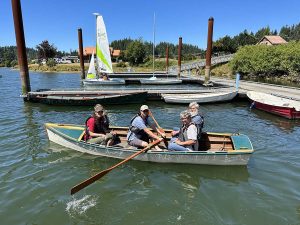
When asked why he does the free days, Novello said, “I was a teacher here, and we’re in a depressed economy. As a kid, I started sailing, and it was my escape. I wanted to make boating available to kids and families and ask only that they bring a smile, and we’ll get them on the water.”
Teak Lady Society
The boathouse also stores three Teak Ladies, 17-foot Sloops built in Ah King Slipway, Hong Kong, between 1937 and 1958. A Teak Lady was first introduced to the port prior to one of its annual Wooden Boat Festivals.
“A man had registered a Teak Lady for the show. He took the boat out in Newport, and he got smashed by a fishing boat and got a hole in the hull. He was broken-hearted but got over it quickly and donated the boat to the boathouse,” Scacco said.
The Retired Old Guys fixed the hole and adopted the boat. That sparked interest and soon two of the Retired Old Guys found other Teak Ladies and donated those as well. At first the boats were used for rides and some training, but the Slough is too small for them. “They are old and need a lot of love and no one has them as a passion project right now. My small budget would be swallowed with the upkeep, but we are keeping them floating while we try hard to find new homes for them,” Novello said.
Yaquina Queen
According to Novello, the pride and joy of the whole boathouse woodshop program is the Yaquina Queen. The 25-foot former German lifeboat, circa 1951, came off a merchant vessel sometime in the late 70s and was brought to the United States and used for salmon fishing. “It was abandoned at the side of the road and somehow ended up at the Port of Toledo. When I saw it, it was filled to the rail with water. I asked the port manager at the time if I could have it. I thought it looked like the African Queen, and I had a vision of creating the African Queen in Disneyland,” Novello said.
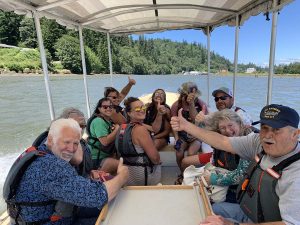
The Retired Old Guys went to work on restoring the boat and reshaping it as a replica of the African Queen, made famous by the 1951 movie of the same name that starred Humphrey Bogart and Katherine Hepburn. The Yaquina Queen is now used for historic tours of the area and attracts visitors from not only around the United States but around the world who learn about it through word of mouth. “Toledo has a rich history so we put together a 45-minute narrated tour. The first guy who did the tour dressed up as Humphrey Bogart. The current skipper is a retired riverboat captain from Mississippi who dresses the part,” Novello said.
Between the Free Family Days and Yaquina Queen tours, the port sees more
than 1,000 people each season, which runs from Memorial Day to Labor Day. Novello said about half are repeat visitors, but they also attract visitors from not just around the country but from around the world. “I’m not sure how they find us, but people from Europe and Asia come each year. We want to do this for the locals so we don’t advertise. We don’t want lines and for families to have to wait,” Novello said.
Novello hopes the concept at the Port of Toledo can be replicated at ports everywhere but realizes in some areas it won’t work. “You must have the right circumstances and support. Small things like the water is warmer in Toledo and the weather a bit warmer than it is right on the coast matter. The port is so supportive and the volunteers come from all over. None of us actually live in Toledo,” Novello said, but they all come to the boathouses each week throughout the year.

| Categories | |
| Tags |