

Collaborating to Cut Dredging Costs
Published on April 1, 2026


Three marinas on the Royal River in Yarmouth, Maine, pooled their resources to improve their facilities and save money on the cost of dredging.
Yarmouth Boat Yard, Yankee Marina and Boat Yard and Royal River Boat Yard split the cost three ways for Patriot Marine, a dredging and engineering service in New Haven, Conn., to go to Maine to dredge each facility’s dockage areas. The navigation channel in the river was not part of the project because it falls under the auspices of the U.S. Army Corps of Engineers (Corps).
“All three marinas work closely on trying to dredge together whenever we can,” Steve Arnold, owner of Yarmouth Boat Yard, wrote in an email. “Yankee Marina and I have always worked together closely in the past, and with the previous dredging we worked together to be able to combine both marinas. This helps pay the mobilization and de-mobilization fee and, in the end, it saves us a lot of money since those fees are approximately $325,000.”
Practical Approach
Yankee Marina and Yarmouth Boat Yard collaborated 10 years ago to dredge their marinas. For the 2026 dredging project, each company paid $55,000 for the transportation of Patriot’s equipment from its headquarters in Connecticut to Maine.
“This is at least the second time we’ve dredged since I’ve been here,” said Deborah Delp, president of Yankee Marina. “We always collaborate because it saves money.” She added that permitting together doesn’t affect the process in the eyes of the Environmental Protection Agency or the Maine Department of Environmental Protection.
Some might be surprised to hear that marinas in Maine contracted with a dredge operator located four hours away by road. “We service all of New England,” said Patriot Marine general manager Tim Linden. “We dredge from Long Island Sound all the way up to the Maine coast.”
The Work
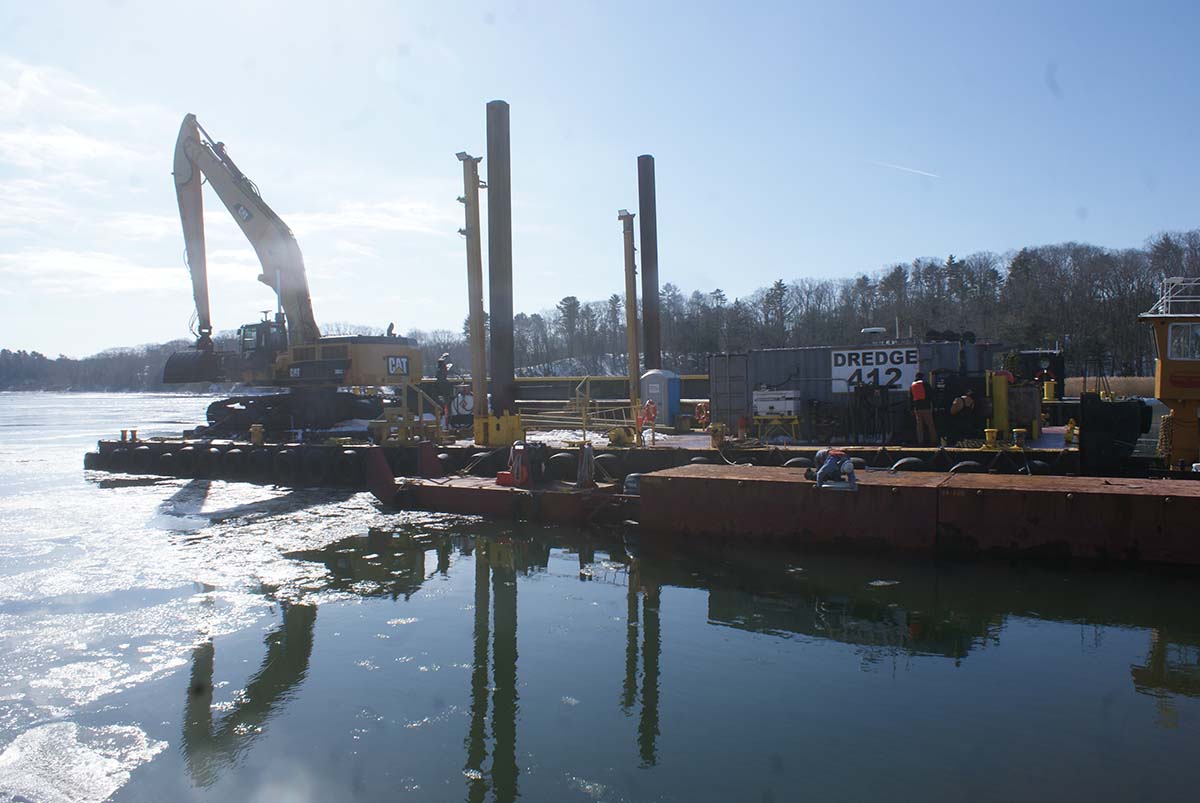
He explained that there are only about five or six dredges in New England that do the kind of work the marinas needed. The only company in Maine that does dredging is Prock Marine in Rockland. It provided the marinas with pricing but couldn’t do the work because of a prior commitment. The equipment that Patriot used for the job is a 4-cubic-yard mechanical dredge that consists of a 110- by 40-foot barge with an excavator on it. It can only be brought up by water, and the trip takes about 36 to 48 hours. Linden was hoping that the work would be done at the end of the week of February 16, but the blizzard that hit New England that week altered those plans. The dredge was scheduled to leave Portsmouth, N.H., on February 27 with the work to be done the following week.
Patriot Marine was contracted to remove approximately 27,000 cubic yards of material from the three marinas. The material was disposed of at one of two sites off the Maine coast designated by the Corps. The Portland Disposal site is about 7.1 nautical miles east of the city of Cape Elizabeth, Maine. The Saco Bay Disposal Site is three nautical miles east of the mouth of the Saco River off Biddeford, Maine.
Having three boatyards participate in the permitting process helps with the efficiency of bottom material testing and hydrographic surveys. If the testing company does all the surveys at the three yards simultaneously instead of one at a time, there’s a cost and time savings for each facility.
Yankee Marina is dredging to a depth of 8 to 9 feet to its outer slips. Overall, the yard has 90 slips, some of which are “mud slips” and can only be used temporarily for smaller boats. Delp said that her facility has more mud.
Yarmouth Boat Yard is located closer to where the freshwater runoff spills into the brackish river, and the current from that pushes mud and silt around the basin where its slips are located.
Yarmouth Boat Yard’s target depth is 8 feet, and Arnold said the dredging will provide a better turning radius at the end of its E-dock, which is the southernmost set of slips in the marina that has moorage for 100 boats up to 46 feet long. Some slips that previously could only be used part-time because of tides will turn into full-use versions. It will also give more space for boats launching at the yard’s ramp to maneuver.
Marina Dock Age reached out to Royal River Boat numerous times but did not get a reply. The marina is the farthest upriver of the three and has 75 slips for a variety of vessels, plus a 75-ton travelift.
| Categories | |
| Tags |