

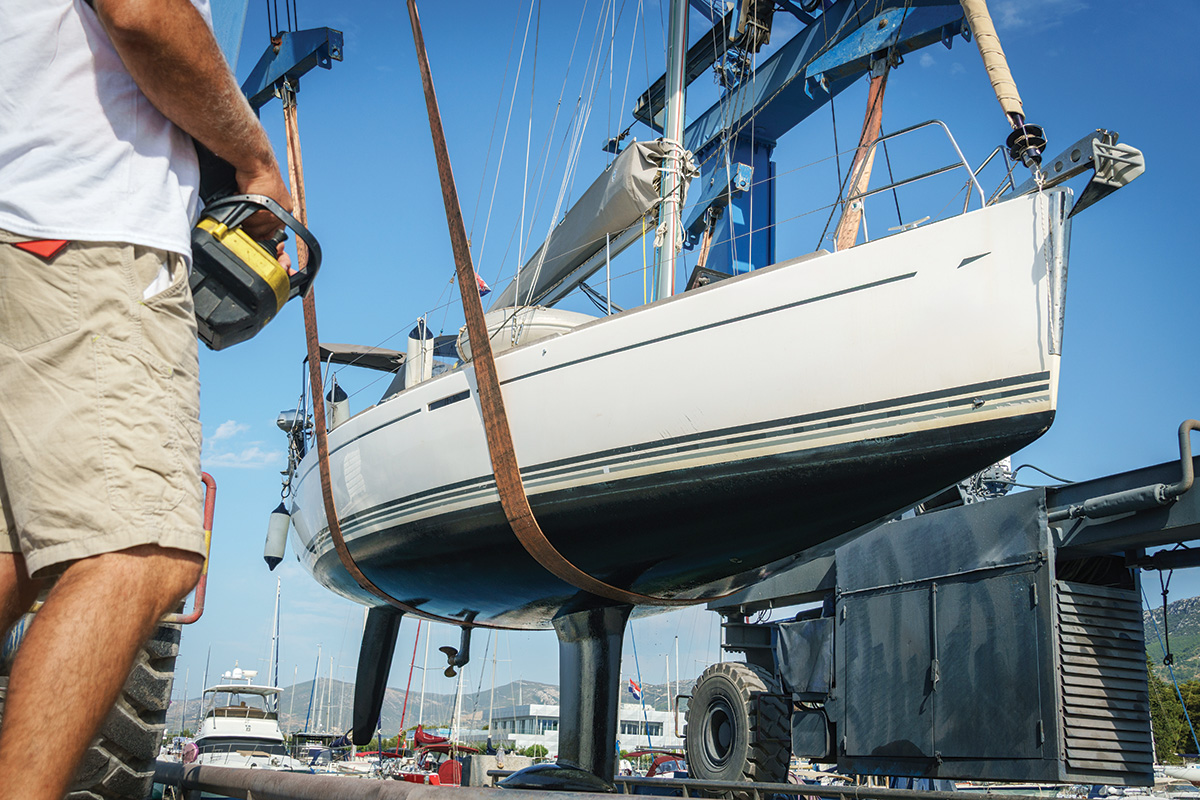
Investing in Equipment and Infrastructure
Published on April 28, 2026


In today’s economy and in the competitive landscape faced by every marina and boatyard, investment in infrastructure, such as dock improvements, dry storage automation and the equipment that is essential in maintaining operational efficiency, impacts every aspect of the operation.
To get the best results from any capital investment, there must be a plan that addresses both the marina or boatyard operation’s short- and long-term needs. A proper plan will save time and resources and result in increased efficiency, a competitive edge, tax breaks, long-term savings and increased productivity.
Equipment and Infrastructure
Successful businesses long ago discovered that their equipment investments directly correlate with operational efficiency, employee satisfaction and competitive advantage. Many of the investments made by boatyard and marina operators are geared toward diversifying revenue beyond the traditional docking fees. Investments in areas such as hospitality (food and beverages, restaurants or hotels) increase revenue and help the operation grow.
Investing in basics such as staff training and clean facilities increases customer retention and, in many cases, will justify premium pricing.
Equipment Investment 101
While the temptation to choose lower-priced alternatives is understandable, particularly for growing businesses watching their budgets, the long-term benefits of commercial-grade equipment far outweigh the initial cost savings of cheaper options.
Keep in mind that the cost of acquiring better-grade equipment will, just as with less expensive purchases, often be reduced with tax breaks, particularly after the passage of the One Big Beautiful Bill Act (OBBBA).
Depreciation Write-Offs
One of the key elements of the 2017 Tax Cuts and Jobs Act (TCJA) was a 100% bonus depreciation write-off that allowed businesses to immediately deduct the full cost of business equipment. Today, the original, full 100% bonus depreciation is back. The deduction will apply through 2029 for property acquired after Jan. 19, 2025.
In addition to bonus depreciation, the OBBA doubled the current Section 179 first-year expensing deduction from $1,250,000 to $2,500,000 and increased the limit on the total amount of business assets acquired during the year that still qualify.
The former $3,130,0000 limitation was increased to $4 million for the 2025 tax year and beyond. In other words, the full deduction would be phased out should the boatyard or marina’s equipment or other asset purchases reach the $4 million ceiling.
The new law also extended immediate write-offs of physical structures, a category traditionally subjected to longer depreciation timelines. Today, a provision of the OBBA will allow qualified businesses to immediately deduct 100% of the cost of new buildings and facilities used for manufacturing, natural resource extraction, electricity and natural gas production, water systems and waste disposal.
However, the IRS has not addressed whether marina or boatyard structures for water systems, water purification or other activities will qualify as “qualified production property” (QPP).
Environmental Property Investments
While seeking IRS guidance is strongly encouraged for the QPP, tax breaks for investing in environmental-related business property are clearer. Those marinas and boatyards that construct, improve or design the building they own to be energy efficient may continue to qualify for the Section 179D deduction for energy-efficient commercial buildings. Under OBBBA, this credit won’t terminate for any property for which construction began before June 30, 2026.
On the downside, properties that fall under the heading of green energy-producing assets or recycling and storage will no longer be considered five-year properties for depreciation purposes. Now these assets will be subject to depreciation using the general class lifetime rules, resulting in smaller depreciation expenses in earlier years.
Tax credits will continue for wind and solar projects that start construction by June 2026 or go online by December 2027.
The Tax Write-Off Myth
While not always the best course of action, today’s tax rules can reduce the out-of-pocket cost of equipment, software and, often, the building housing the marina or boatyard operation. It is important to remember that equipment purchases reduce taxable income, not the taxes owed, on a dollar-for-dollar basis.
The myth and the year-end tax scramble results from two fundamental misunderstandings. First, the strategy treats bonus depreciation, Section 179 expensing and other write-offs as one-to-one reductions of what is owed. Those write-offs reduce taxable income that is then taxed at the boatyard or marina’s marginal tax rate, typically 25% to 30%.
Far too many marine industry professionals make investment purchasing decisions based on incomplete information about their actual tax liability. If the investment in new or improved equipment will increase the operation’s income in later years, wouldn’t the tax deduction produce a better result in those more-profitable, higher tax bill years?
Investing in equipment, software or other business assets won’t automatically result in an equivalent reduction in the marina or boatyard operation’s tax bill. A full write-off in the year of acquisition may be more profitable if claimed as depreciation deductions spread over more than the life of that property. Still remaining, however, is the question of how best to fund any investment in equipment.
Financing Equipment Investments
For many boatyards and marinas, investing in the right equipment is the key to being competitive, expanding or increasing efficiency.
The key to maximizing these benefits lies in viewing equipment purchases as long-term strategic decisions rather than simple cost centers. By focusing on total cost of ownership, operational impact and strategic value rather than just upfront costs, businesses can build the foundation necessary for sustained growth and success in increasingly competitive markets.
Unfortunately, funding for investments in those critical equipment replacements and upgrades can be challenging. That’s where business equipment financing enters the picture.
Equipment financing helps businesses invest in the tools they need to stay competitive while preserving their working capital. In general, equipment financing is a type of loan or a lease available from a variety of sources, allowing the boatyard or marina to purchase needed equipment without using cash.
Whether seeking funding from a bank, online lender, equipment finance company, dealer or manufacturer, keep in mind that not all financing partners are created equally. Traditional banks usually offer lower rates but have stricter requirements.
Online lenders can mean faster approvals and more flexible terms but higher rates. Specialized equipment lenders offer industry expertise, flexible terms and are more knowledgeable about assets.
Capping Interest
A word of warning is important about the tax rules that have long placed a limit of 30% of an operation’s gross income on the amount of interest paid by a business that could be claimed as a tax deduction. Fortunately, small businesses, which are defined as businesses whose average annual gross receipts for a three-year period that in 2025 did not exceed $31 million, remain exempt.
The OBBB retained the Business Interest Expense (BIE) limitation and restored the add-backs for depreciation, amortization and depletion deductions. That change will result in a reduced adjusted taxable income (ATI), the base upon which the limit is applied, thereby reducing annual business interest expense deductions for many taxpayers. What’s more, any disallowed BIE can usually be carried forward indefinitely.
Successful business owners and managers long ago discovered that investing in their operations impacted the operation’s efficiency, employee morale and its competitive advantage. For many marinas and boatyard operators, investments are often geared toward diversifying revenue beyond the traditional docking fees.
The Bottom Line
Investing in equipment can lead to significant long-term savings, making it a strategic choice for sustaining the financial health of a marina or boatyard. Among the warning signs that indicate such investments should take place are:
Rising repair costs and frequent breakdowns
Operational disruptions due to outdated machinery
Inability to meet demand or quality standards
Safety hazards or security vulnerabilities
Investing in quality business equipment represents a strategic commitment to operational excellence, employee satisfaction and long-term business success. While the initial investment may require careful financial planning, the comprehensive benefits, which range from improved productivity and reduced maintenance costs to enhanced brand image and competitive advantages, make quality equipment one of the most valuable investments any business in the marine industry can make.
The key to making the most of these benefits lies in viewing equipment, software or any business asset purchases as long-term strategic decisions rather than simple expenditures. Naturally, before the boatyard or marina’s next equipment purchase, the total cost of ownership over the expected lifespan should be calculated, as well as how the investment aligns with the operation’s long-term business objectives.
Boatyard and marina operators are heavily investing in their operations to shift from traditional “mom and pop” operations to institutional-grade, amenity-rich and technologically advanced facilities. Driven by consolidation and demand for larger vessels, these investments focus on maximizing revenue per square foot through improved infrastructure, expanded services and digital, customer-focused operational tools.
The decision to prioritize quality over cost will pay dividends to the marina or boatyard for years to come.

| Categories | |
| Tags |