

Maintenance and Repair Strategies for Marinas
Published on April 28, 2026


Maintenance and repair expenses can make or break the financial performance of any marina, and unexpected expenses can be especially bad news, which means the difference between profit and loss for the year. Equally important, the effect of deferred maintenance and/or damage that is not repaired promptly can create liability issues, injury lawsuits, and a loss of customers leaving for facilities that are in better shape.
They say the best day to plant a shade tree was 20 years ago, and the second-best day is today (to prepare for the future). The same goes for managing and reducing long-term maintenance and repair costs in marinas, meaning that the original design of a marina makes a big difference in how much effort and expense you will face long-term. Designing and building a marina from scratch will result in a long list of decisions that will include tradeoffs between initial construction costs and long-term durability. Meanwhile, the owner of a 35-year-old facility that needs a lot of work will be faced with a similar set of decisions.
Materials and Design Details
Let’s use steel sheet pile as an example. In some cases, “pay me now or pay me later” means increasing the thickness and length of your steel sheet pile during construction rather than replacing shorter sheets of lightweight steel that may fail in 20 years or less. Obviously, no one can afford to build everything exactly how they would like under ideal circumstances, so how does an owner decide?
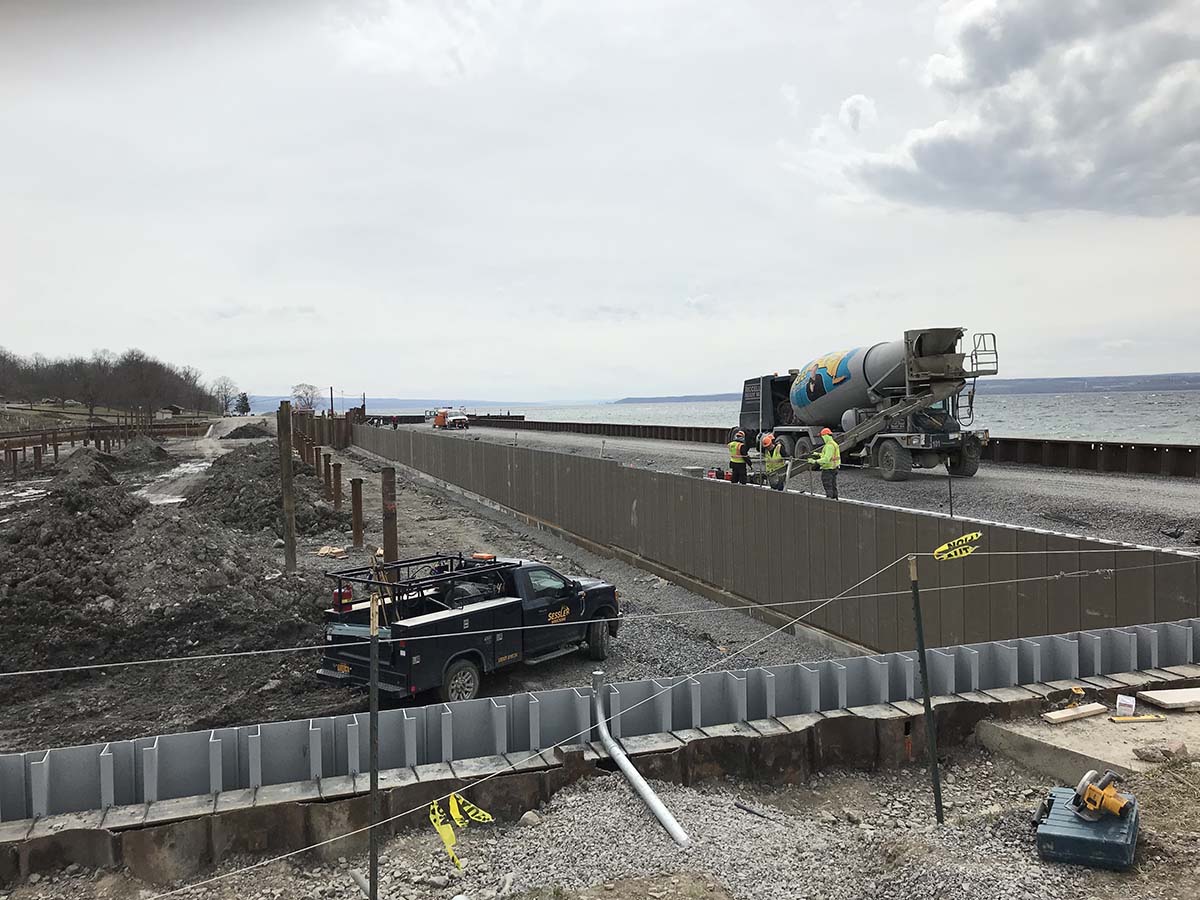
In the Great Lakes, steel sheet pile walls of an appropriate thickness and installed depth can last 50-75 years or more, while also supporting high loads very close to the wall structure for winter boat storage. If the wall is not designed for the upland loads, a marina would either lose that winter storage revenue or, worse, damage the wall or drop a boat. When the wall eventually needs to be replaced, the standard approach is to drive new steel sheet pile in front of the old wall. While this is a reasonably cost-effective approach, it also means losing two feet of the marina, while also potentially having to move fixed or floating infrastructure accordingly. While this doesn’t sound like much, what happens if the marina is configured in a long, narrow basin that is only 140 feet wide? What started as two sets of 40-foot slips with a 60-foot fairway becomes a 56-foot fairway once two feet are lost on each side. If a marina owner uses a very lightweight sheet and needs to do this every 20 to 25 years, the facility will eventually have 35-foot slips instead of 40-foot slips and an associated loss of revenue.
Marina owners need to consider how long they plan to own the facility and how much it will be worth when they are ready to sell it. The cost of short, light-weight sheet pile walls that might last 25 years or fewer could be $1,000 per linear foot, whereas the more durable 50- to 75-year design might be $3,000 per linear foot. Only the owner can decide which approach makes more sense. This also needs to be considered for those inspecting a marina as a potential investment. A 15-year-old marina might look great on the surface, but it is imperative to ask to see the drawings and specifications and have a qualified engineer look things over so there aren’t any unpleasant surprises.
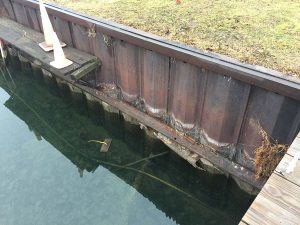
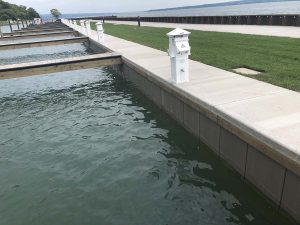
For the marina owner who has walls that are failing and is looking at a seven-figure repair bill, it is worth considering all options and getting creative with an engineering team. One option could be to abandon steel altogether and consider a hybrid strategy of composite steel sheet with concrete backfill if the original wall’s tieback system is sound. Another option would be to leave the existing wall in place and place armor stone in front of the wall. A short steel sheet or a deeper 24- to 30-inch concrete curb wall placed at the interface of the wall and top of stone can create a clean edge. While this can be much less expensive than steel sheet pile, it will also reduce the navigable area of the marina and may be difficult to permit in some jurisdictions that place a high emphasis on reducing the amount of fill placed in the water.
Pushing creativity to the next level, what if reconfiguring the marina basin entirely is the best approach? If the marina is one of those older facilities with several long, narrow basins, there might be a mile or more of sheet pile wall. Seven thousand linear feet of the more durable wall at $3,000 per linear foot might cost $21 million, and 5,000 linear feet of the lower cost wall at $1,000 per linear foot would cost around $7 million. If the basin is reconfigured to a more modern, open basin layout with longer piers, the length of the wall could be reduced to around 2,000 linear feet. Then the more durable/higher cost wall could be built for only $6 million. This would mean paying less overall for the higher quality wall and ending up with a more efficient marina with more slips. It will also likely have better water quality and could be easier to permit.
It is important to consider all the economic factors at play. First, consider all income streams. If the proposed solution reduces the amount of space available to store boats during the winter, add that lost revenue to the cost. If the facility is losing a navigable area and must reduce the size of the slip, add that lost revenue to the cost. If the fix requires more labor from staff, add that cost as well. If the fix lowers the perceived quality of the
facility, consider that long-term impact as well. Also consider the anticipated lifespan of the repair, replacement time and lifecycle cost. If the solution that costs three times more lasts three times as long, the price is the same in the long run. This also reduces the risk of future price increases that have become more and more unpredictable. The price of steel, for example, has increased 70-80% since 2020. Additionally, the cost of disruption to daily operations during a major infrastructure project can be high.
Selecting Products
Marina owners often want to know what the best dock is on the market. The truth is that there is no one product that is “the best” in all conditions, but there are usually several products available that will work very well in a particular environment, while other products are better in other locations.
Investing in products from reputable manufacturers, selected specifically for certain locations and site conditions, is one of the best ways to reduce long-term maintenance costs. The cheapest dock to buy upfront is rarely the lowest cost dock overall when considering the full life cycle, especially when it comes to maintenance and overall customer satisfaction.
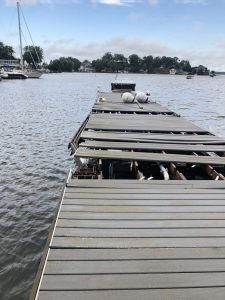
The owner of a marina located on a large inland lake connected to Lake Michigan asked a local fabricator to build a floating wave attenuator rather than buying a proven product. The design was a massive steel structure that by all appearances should have been able to stop anything. During the first major storm, the connection points between the attenuator sections failed.
After insurance paid for those connections to be massively reinforced, the attenuator failed again, but this time in the middle of the structure. The insurance company offered one final payment and dropped the marina. A reputable manufacturer will be upfront if their product is not a good fit for a particular site. Ask to review the site with their in-house engineering team, including a site visit if the facility is subject to higher waves or significant ice build-up.
Make a Plan
Damage in marinas is a fact of life, be it a hurricane, tornado, snowstorm, ice or simply age. Depending on the wave climate, a quality floating dock system generally has an expected life of 25-30 years, and possibly 40 or more years for floating concrete or fixed docks. If a facility is anywhere over 20 years old, the time to develop a long-term master plan is now. At this age, things will break more often, and maintenance costs will climb. If a master redevelopment plan is in place, any repairs made will be within the context of a long-term redevelopment strategy. Every dollar invested is one dollar closer to building the plan. Boaters will appreciate seeing the big picture, and seeing a plan implemented one step at a time demonstrates a commitment to quality and safety worth paying for. Raising rates year after year with no apparent improvements in the marina and no obvious plan is a sure path to annoyed customers.
Think about the long-term costs rather than just the quickest, lowest-cost solution, and the facility will be safer, more durable and more valuable.

| Categories | |
| Tags |