

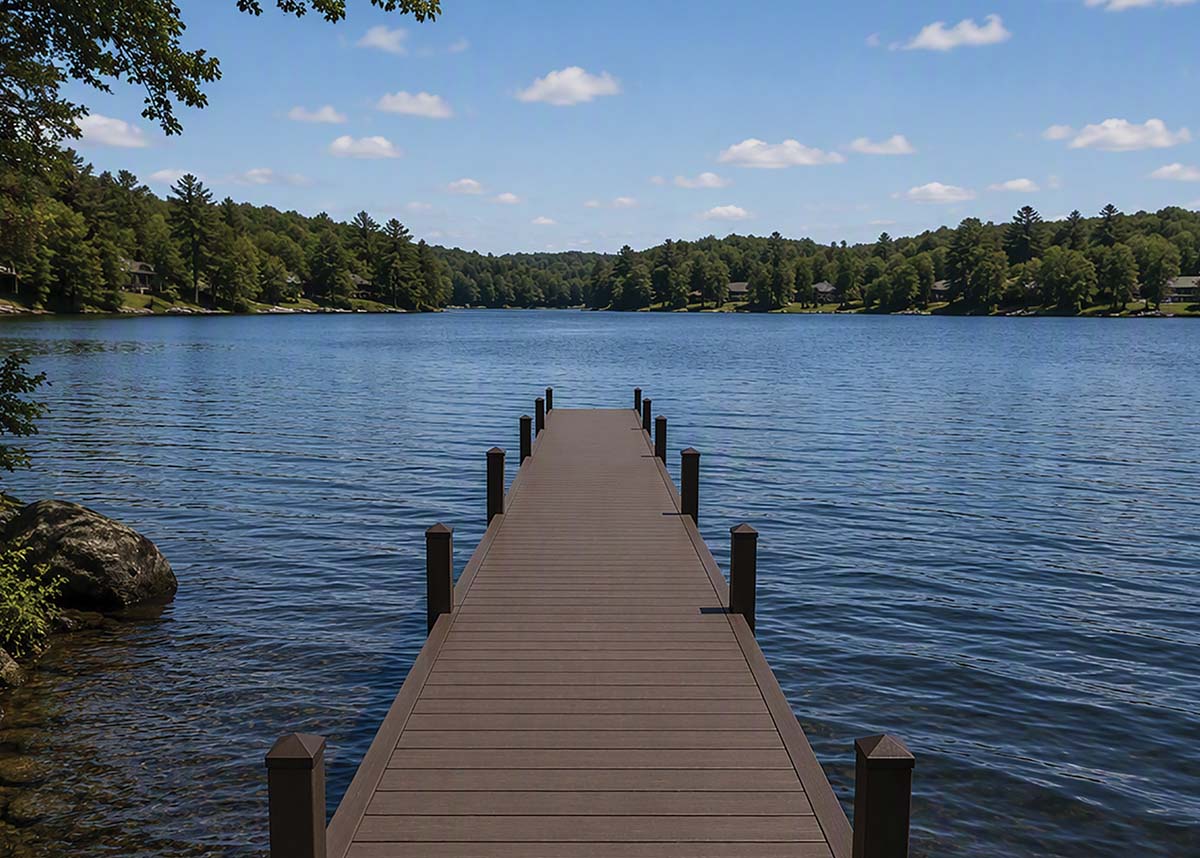
Plastic Lumber Offers Durable Option for Marine Applications
Published on October 29, 2026


Marinas and dock owners are constantly battling the effects of water, weather and heavy use. From dock decking and walkways to structural components, the materials used in waterfront construction must withstand prolonged exposure to the elements while providing a safe and durable surface for boaters.
While treated wood has long been a common choice for docks and marina construction, engineered plastic lumber is another option for owners looking to reduce maintenance and extend the service life of their infrastructure.
Marine-grade plastic lumber is an engineered building material designed for outdoor environments where moisture exposure is constant. Unlike traditional plastic lumber products that are primarily intended for non-structural applications, some newer products are reinforced and designed for structural uses.
Ethan Peterson, business development executive for PolyScape, said fiberglass reinforcement is a key distinction between structural-grade plastic lumber and traditional plastic lumber.
“Marine-grade plastic lumber is an engineered building material designed to perform in demanding outdoor environments where moisture exposure is constant,” Peterson said. “PolyScape Ultra Grade is a structural-grade plastic lumber product made from fiberglass-reinforced polyolefin.”
PolyScape Ultra Grade is manufactured from fiberglass-reinforced polyolefin and contains less than 25% inorganic filler. Fiberglass accounts for at least 15% of the product’s total weight and provides the structural properties needed for beams, joists, posts and other load-bearing applications.
The material is manufactured in Minnesota using upcycled plastic materials, including materials recovered through Bedford Industries’ TagBack recycling program and closed-loop manufacturing processes.
For marine applications, resistance to moisture is one of the material’s primary characteristics. Docks and marinas are exposed to water, temperature changes, insects and ultraviolet radiation throughout the year.
“Waterfront environments are among the harshest settings for traditional building materials,” Peterson said.
PolyScape is designed to withstand those conditions without rotting or decaying when exposed to moisture. The material is also not chemically treated, which Peterson said can make it an alternative for projects where long-term durability and reduced maintenance are priorities.
Plastic, Wood And Composite
Traditional treated lumber remains a familiar material for docks and other waterfront structures. Its long history in the marine industry has made it a common choice, but exposure to water and weather can create ongoing maintenance requirements.
Marina owners can face recurring concerns such as rot, moisture damage, insect activity, splintering and the eventual replacement of deteriorated components.
Plastic lumber is designed to address many of those concerns. PolyScape does not rot or decay in the presence of moisture, dirt or insects and does not require chemical treatments to achieve durability. The material also eliminates concerns related to splintering and does not require painting, staining or sealing to maintain its durability.
Routine cleaning is generally all that is needed for most applications, according to Peterson.
Because plastic lumber is an engineered material rather than a natural product, it also offers dimensional consistency compared with wood products. This can help reduce some of the warping and movement associated with traditional lumber.
Plastic lumber can also be compared with composite decking, although the materials are not necessarily designed for the same applications. Many composite decking products are designed primarily as a decking surface and may combine wood fiber with plastic.
PolyScape, meanwhile, can be manufactured in dimensional lumber profiles, with Ultra Grade reinforced with fiberglass for structural applications.
The distinction becomes particularly important when a material is being used for more than a walking surface. Deck boards have different requirements than beams, joists, posts or columns supporting a dock.
Structural Applications
One recent development in engineered plastic lumber is the availability of third-party structural evaluation and engineering data.
PolyScape Ultra Grade recently received a DrJ Listing and Technical Evaluation Report, TER 2506-104. The report recognizes the product as structural-grade, fiberglass-reinforced plastic lumber for applications including decks, boardwalks, docks, platforms, beams, joists, posts and columns.
The report includes approved design values, allowable spans, post capacities, fastener performance data and installation requirements.
“The TER provides independent third-party evaluation confirming that PolyScape Ultra Grade complies with the applicable building code requirements covered by the report,” Peterson said.
For engineers and contractors, the report provides structural design information that can be used when planning projects. Peterson said the availability of approved span tables and structural design values is one of the biggest advancements for structural plastic lumber.
“Historically, plastic lumber has often been viewed as a specialty material requiring project-by-project engineering review,” Peterson said. “TER 2506-104 provides established design criteria for joists, beams, posts, columns and framing applications.”
The report can also be submitted to building officials when product evaluation documentation is required.
For marina owners, the availability of this information provides another factor to consider when evaluating materials for dock construction and renovation.
Looking At Lifecycle Costs
The initial cost of a material is only one consideration when planning a dock renovation or new construction project. Marina owners also must consider maintenance, replacement cycles, environmental exposure and the difficulty of accessing waterfront structures for repairs.
Peterson recommends that marina owners consider total lifecycle costs rather than focusing solely on upfront material costs.
“The first considerations should be the project’s structural requirements, desired lifespan, environmental exposure and maintenance expectations,” Peterson said.
For projects exposed to constant moisture or frequent maintenance challenges, materials designed specifically for those conditions may provide an alternative to traditional products.
PolyScape is designed for year-round outdoor use and has been tested for freeze-thaw performance. According to the technical evaluation report, the material has a water absorption value of approximately 0.019%.
The material is also available in multiple structural profiles, allowing it to be used for different applications depending on the requirements of the project.
Peterson said another misconception about plastic lumber is that the products all have the same appearance or performance.
“Early generations of plastic lumber sometimes earned that reputation, but the industry has evolved significantly,” Peterson said.
PolyScape incorporates features such as woodgrain textures, refined surface finishes and multiple colors designed to provide an appearance closer to natural wood.
More importantly, Peterson said, plastic lumber products vary significantly in their intended uses. Some are designed for non-structural applications, while others are engineered for structural work.
As marinas continue to renovate aging docks and waterfront infrastructure, material selection will remain an important part of those projects. For marina owners, the combination of durability, reduced maintenance and structural design information could make engineered plastic lumber an option worth considering for future construction and renovation projects.

| Categories | |
| Tags |