

The Movement Problem Many Marinas Miss Until the Weekend Rush
Published on July 1, 2026


The busiest days at a marina are often the ones that reveal the most about how a facility really operates. On paper, everything looks great. The wet slips are full. The dry stack is reaching capacity. Boat traffic is steady. Owners are happy. Then a holiday weekend comes, and suddenly, the launch queue is growing longer than anticipated, and staff are scrambling to keep things moving.
Most owners would stand by with their arms crossed and think they need more storage for more boats. The problem is usually something else entirely.
It’s not always about where the boats are being stored. It’s how they’re moving through the marina.
A marina can have plenty of available storage and still struggle during peak demand if boats can’t be efficiently launched, retrieved, staged, serviced and returned. Vessel movement throughout a marina is one of the most overlooked factors in planning and operations. Most boaters never think about it, nor should they.
A well-run marina feels effortless from the customer’s perspective. The customer arrives, the boat is ready, and he or she is on the water. When that process takes longer than expected, conflict follows. Staff spend more time managing traffic. Launch areas become crowded. Service operations compete for space. Customers begin to notice delays.
Those issues rarely appear overnight. More often, they develop gradually as demand increases and the facility begins operating in ways it wasn’t originally designed to support.
The Real Challenge Is Movement
For years, marina planning usually started with the topic of storage. How many slips can fit? How many racks? And how much land is left if the owner wants to expand later?
These questions do matter, but they can give owners a false sense of comfort.
The better test is to walk a boat through the marina from start to finish. Where does it go after it comes out of the rack? How many boats can sit there before the launch area gets blocked? Can a mechanic get a boat to service without crossing the main customer route? Let the boat tell you where the layout works and where it doesn’t work.
The Right System Needs the Right Layout
Boat lifts are a big part of this, but not in the way people sometimes talk about them. A lift isn’t just a piece of equipment sitting at the water’s edge. It directly impacts how the marina operates, and every marina handles it differently.
Individual Slip Lifts: Popular in wet-slip environments where owners value direct access to their vessels. These systems allow boats to remain at the dock while providing protection from prolonged water exposure.
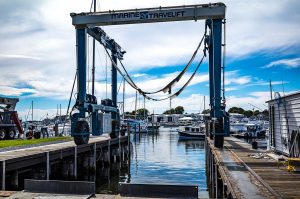
Travel Lifts: Widely used for haul-outs, maintenance operations and vessel launching. Their flexibility makes them a valuable tool for marinas that support a variety of vessel sizes and service needs.
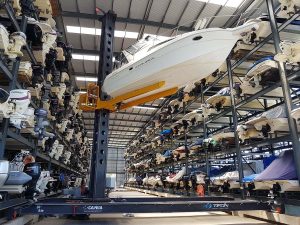
Forklift-Based Drystack Systems: One of the most common drystack solutions. They make efficient use of vertical storage space while providing operators with flexibility in how vessels are stored and retrieved.
Crane-Based Retrieval Systems: Often used in higher-density drystack facilities. Because the equipment follows defined travel paths, these systems can provide consistency in vessel handling and storage operations.
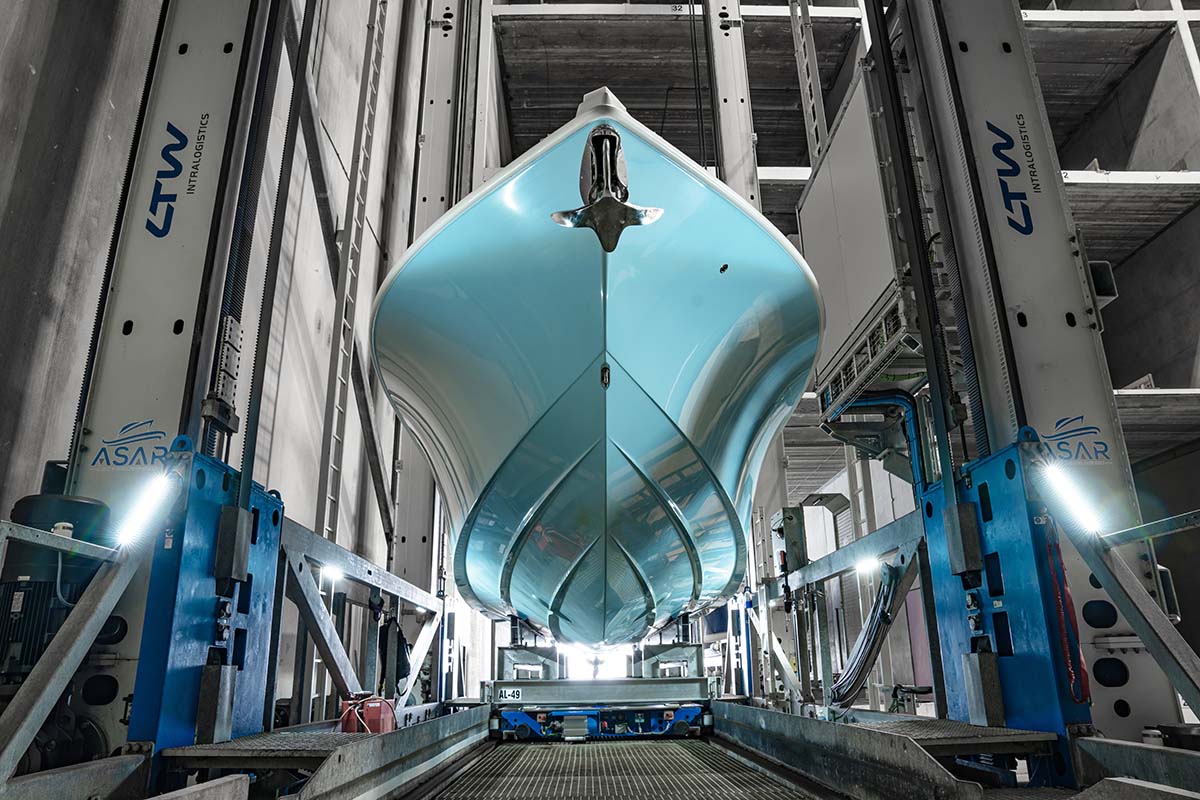
Automated Storage and Retrieval Systems: Designed for facilities seeking highly organized vessel storage and retrieval. By automating movement within the storage structure, these systems can provide predictable retrieval processes, reduce manual handling and support high-density storage environments.
None of these systems is inherently better than the other. Each serves a different purpose, and each can be highly successful when matched to the right site, operational goals, customer expectations and budget.
The real question is whether the rest of the marina has been designed around the way that chosen system moves boats.
When the System Falls Behind
Many times, good equipment gets blamed for problems that started 20 yards away from the lift. Sometimes the staging area is too small. Sometimes the launch zone is being used as a service pass-through. Sometimes the fuel dock becomes the place boats wait because there is nowhere better for them to go. Sometimes returning boats and outbound boats are being routed through the same narrow spot at the worst possible time of day.
In those cases, the lift may be doing exactly what it was bought to do. The layout around it just has not kept up with how the marina is being used.
The best time to catch that is before the busy season makes it obvious. Before construction, expansion or equipment selection is complete, someone needs to picture the hard days, not the average ones. A normal weekday will rarely reveal the weakness in a marina layout, but a summer Saturday will provide a glimpse into how smooth operations are going.
How many boats need to be launched before 10 a.m.? Where do boats wait when they come back after launch? Can service crews still do their work while customers are arriving? What happens when bad weather rolls in and everybody wants to return at once?
These are not complicated questions, but they change the planning stages of a marina’s development. They force the discussion away from simply counting storage spaces and toward understanding how the property will actually work.
Good Flow Doesn’t Happen by Accident
The marinas that seem calm on busy days aren’t always the ones with the most land or the best equipment. Often, they’re the ones where movement was thought through in the early planning stages.
The facility gave boats somewhere to go, kept customer traffic separate from service traffic, gave staff enough room to work and selected equipment that fit the site instead of forcing the site to adapt to the equipment.
Boat lifts deserve a larger role in marina planning. They affect a lot more than the moment a boat is lifted or launched. They influence how staff move, how customers experience the development and how well the marina holds together when everyone has the same boating plans on the same holiday weekend.
When it is done well, most customers never notice it. That is the point. The boat is ready, the path is clear, and the day feels simple.
Marina owners spend a lot of time thinking about where boats will be stored. They should spend just as much time thinking about how those boats will move. On the busiest days of the year, that difference becomes very easy to see.
Robert Brown is the founder and CEO of GCM Contracting™ and Marina Partners™, where he works closely with marina owners and developers to plan and deliver drystack facilities. He can be reached at rbrown@gcmcontracting.com.

| Categories | |
| Tags |