

What Marina Automation Really Changes and What It Doesn’t
Published on March 2, 2026


Over the last decade, marina development has begun to evolve in meaningful ways. Owners are thinking differently about layout, operations and safety, and increasingly about the experience they deliver to boaters. Amenities, reliability and operational professionalism now carry more weight than they once did.
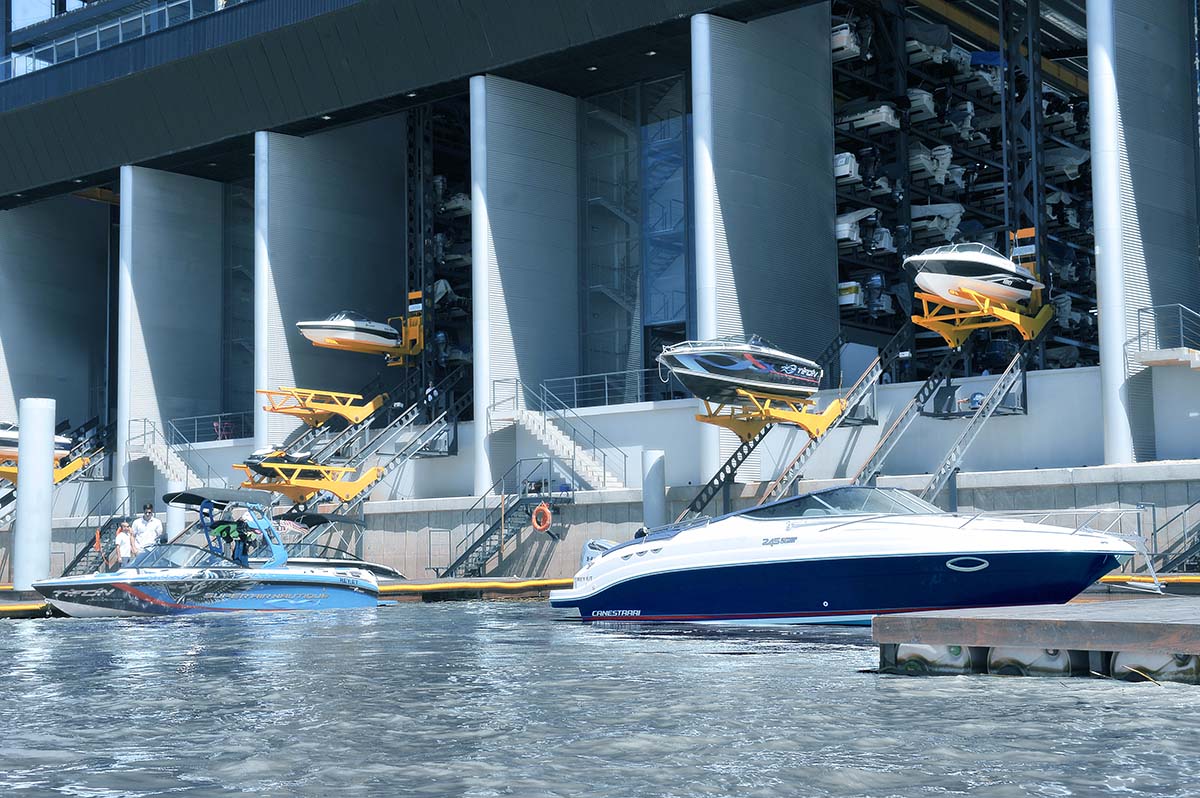
Automation is the newest entrant in that evolution. Modern drystack delivery systems introduce capabilities that were not previously available at scale. They change how vessels are stored, moved and retrieved, particularly in dense or vertically constrained environments. At the same time, these systems do not replace the fundamentals that still define successful marina operations.
As this technology moves from early adoption into real projects, owners are faced with an important task. They must understand what modern drystack delivery systems genuinely change and where operational realities still apply.
Delivering Value
At their most effective, modern drystack delivery systems introduce consistency into operations that have traditionally been highly variable. Mechanized delivery and retrieval systems move vessels along defined paths with controlled, repeatable motion, producing predictable cycles rather than outcomes dependent on individual operators.
Whether fully automated or operator assisted, modern drystack delivery systems introduce a level of consistency that has historically been difficult to achieve.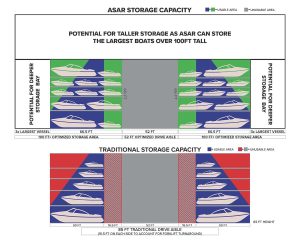
“With crane-based systems, consistency comes from controlled, repeatable movement,” said Andrés Capria of Capria, a provider of semi-automatic crane-based marina systems. “When storage height is no longer tied to aisle width, and boats move along defined paths, you reduce the variability that traditionally comes from manual handling, staffing shifts and peak demand.”
In practice, the most significant value driver owners point to is not speed alone, but space efficiency. Modern drystack delivery systems unlock cubic density by enabling vessels to be stored multiple deep and at greater heights. This allows operators to dramatically increase capacity within constrained footprints. In waterfront environments where land is limited, entitled or expensive, expanded use of vertical and cubic space often defines the financial viability of a marina project.
For some owners, these density gains open the door to a broader redevelopment conversation. Aging drystack barns designed around forklift aisles and manual handling may no longer align with today’s operational or financial goals. In those cases, automation becomes part of a larger repositioning strategy, allowing owners to redevelop outdated facilities into higher performing assets built around modern storage, circulation and customer experience.
This consistency becomes especially valuable during high-volume periods. Modern drystack delivery systems can stabilize launch and retrieval throughput without requiring proportional increases in labor or expanded maneuvering space. Over time, that predictability supports better scheduling, reduced congestion and a more controlled operating environment.
Labor deployment is another area where owners often see meaningful impact. By reducing repetitive lifting and manual handling, these systems allow teams to shift toward supervision, maintenance and guest-facing responsibilities rather than constant equipment operation.
Modern drystack delivery systems can also optimize drive aisle width and enable multi deep storage configurations. This allows operators to significantly increase cubic density and usable space within the same footprint. One fully automated example in operation today is ASAR™, deployed at Gulf Star Marina in Fort Myers, Florida, where multi deep storage is actively in use.
Semi-automatic, crane-based systems deliver additional value through adaptability. In retrofit scenarios, these systems can be integrated into existing drystack facilities, in some cases installed over flooring damaged by years of forklift traffic. This allows owners to modernize operations, improve handling consistency and extend the usable life of existing assets without full facility replacement.
An often-overlooked advantage of modern drystack delivery systems is reduced operational noise. Many crane-based and automated systems operate more quietly than traditional forklift-driven facilities. This increasingly influences permitting, zoning approvals and community acceptance. In noise-sensitive waterfront environments, quieter operation can ease entitlement challenges and expand where marina projects are feasible.
Safety Improvements
Boat handling has always carried inherent risk. Modern drystack delivery systems reduce exposure by limiting the number of handling movements and enforcing precise placement within defined clearances. Fewer handoffs mean fewer opportunities for damage. “Crane-based systems reduce risk by design,” Capria said. “Fewer handling movements and precision-controlled placement lower the opportunity for damage.”
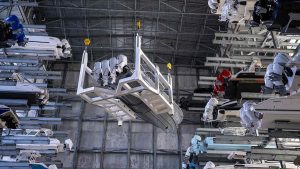
When paired with trained operators and disciplined procedures, those safety benefits are reinforced and sustained over time. Training, clear protocols and oversight ensure that systems perform consistently and as intended across varying conditions and demand levels.
Owners who see the greatest safety gains are those who integrate modern drystack delivery systems into a broader operational framework. This allows technology and teams to work in concert rather than in isolation.
Limitations of Automation
The limitations of automation are not weaknesses of the technology, but reflections of the operational environments in which it is deployed. While modern drystack delivery systems can materially improve launch and retrieval performance, they operate within real world constraints, particularly when it comes to vessel return volume.
One of the most common challenges occurs during major holidays and peak boating weekends, when large numbers of vessels return to the facility at the same time. While modern drystack delivery systems can continue launching and retrieving boats efficiently, often allowing parallel activity inside storage barns while washing, flushing or staging occurs, those vessels still must be processed back into storage.
Operationally, staff must receive, stage, rinse and restore boats just as they would in a traditional scenario. Without adequate staging areas, wash capacity and return sequencing, congestion is inevitable, regardless of how advanced the delivery system may be.
Modern drystack delivery systems offer greater customization to address these pressures. Automated rinse downs, automated drying cycles and parallel movement within the storage structure can materially improve flow. However, automation works within operational realities and must be aligned with thoughtful return planning. Throughput back into storage remains one of the most critical constraints during peak demand periods.
Site planning continues to play a defining role. Yard geometry, rack configuration, circulation paths and access points directly influence return efficiency. Automation can surface bottlenecks more quickly by removing human variability, reinforcing the importance of early planning and adequate staging capacity.
Automation enhances execution, but leadership and operational clarity still define the experience. “Automation changes how assets move, not how decisions get made,” said John Matheson of Founders 3. “These systems can give operators more predictable outcomes in dense, vertical environments, but leadership, training and customer communication still define the experience.”
Evaluating Automation
As modern drystack delivery systems enter more real-world marina projects, owners benefit from evaluating them based on performance rather than presentation. A practical approach is to focus on a small set of operational questions:
• How does the system perform during peak demand, not just average days?
• How well does it integrate with existing workflows and scheduling practices?
• What do maintenance, uptime and redundancy look like over the long term?
• What is the true total cost of ownership, including service, training and downtime risk?
• What is the maximum vessel size the system can accommodate, and how many boats can it reliably support within the available footprint?
Speaking directly with operators at comparable facilities often provides more insight than demonstrations alone. Automation should be evaluated as part of a complete operational and financial strategy.
Well Planned Developments
When applied thoughtfully, modern drystack delivery systems function as a force multiplier for well-planned developments. They amplify the effectiveness of good site design, disciplined operations and experienced teams.
From an owner and investor perspective, one of the most tangible impacts is operational cost reduction. By minimizing manual handling, reducing labor intensity and increasing predictability, modern drystack delivery systems can reduce operational costs by more than 70%. In many cases, that translates to annual savings exceeding $1 million, depending on the size and throughput of the marina.
These systems also enable higher density, greater vessel mix flexibility and improved asset utilization. These are key drivers of long-term value in constrained waterfront environments. Strong fundamentals still determine outcomes, and automation works best when paired with experienced leadership and disciplined execution. Owners who approach automation as one component of a broader development and operational strategy tend to see the most durable financial and operational results.
Better Tools, Same Fundamentals
Modern drystack delivery systems change how vessels move, how consistently operations perform and how reliably facilities operate over time. They improve predictability, enhance safety and unlock efficiency when aligned with the right site and team.
What they do not change are the fundamentals that define successful marina assets. Good planning still matters. Strong leadership still matters. Clear communication and operational discipline still matter. Used wisely, automation allows those fundamentals to be delivered more consistently and at scale.
David Brown is a business development leader at Marina Partners™, where he focuses on next-generation marina development strategies across drystack storage, automation and complex waterfront environments. He also supports the integration of modern drystack delivery systems through ASAR™, Marina Partners’ automation platform. For more information, visit marinapartners.com.

| Categories | |
| Tags |